
Our Editor’s Best Industrial Drive Flat Belts Reviews

- Type: Flat Belt
- Material: nylon
- Nylon ChipBase band High Speed Drive Conveyor Flat Belt
- Nylon sheet belt has the characteristics of light weight, high strength, small elongation, good oil resistance and wear resistance, soft belt body, etc.
- The light conveyor belt has the characteristics of thin, soft, good elasticity, small elongation, stable operation and long service life

- Oil-resistant, non-marking cover Static conductive
- Single Ply
- Endless woven polyester cord

- Oil-resistant, non-marking cover Static conductive
- Single Ply
- Endless woven polyester cord

- 【Parameter】:Rated Voltage: 110V/60Hz,Motor Power: 120W,PVC Belt Width: 15.7inch/40cm,Conveyor Length:59inch/150cm,Conveyor Height:29.5inch/75cm,Speed:0-18m/min
- 【Adjustable Speed】:Intelligent speed regulation, the speed can be arbitrarily adjusted, running smoothly,.The speed can be adjusted from 0 to 18 meters per minute,Simple operation.
- 【Cleat Design】 It is with cleat on two sides for protecting the objects from falling off the conveyor belt,also can be used with ink jet printer.
- 【High Stability】:This conveyor belt with automatic speed and steady speed circuit of the electronic governor.The motor has strong power, low noise, safe and reliable.Belt with Italian High Anti-Static PVC Industry,Wear and corrosion.
- 【Widely Used】:It's applicable in many industries, chemical, cosmetics, and food and beverage. This is mainly used for conveying glass bottles, plastic bottles, bottle caps, plastic bags, paper boxes, cartons, labels, etc.

- Model:125J6; Effective Length: 12.5" (317mm); Width: 0.55" (14mm); Thickness: 0.14" (3.5mm); Belt Angle: 40 degrees.
- Made of nitrile butadiene rubber material, high-temperature resistance, oil resistance, wear resistance, and high coefficient of friction.
- The multi-rib belt offers the flexibility of a flat belt while delivering the high power transmission performance of a traditional V-belt.
- Fit for many industrial machinery, appliances, and power tools, such as small compressors, pumps, lawnmowers, drills, and saws.
- Notice: Proper belt tension and pulley alignment should be maintained during operation. Too little tension may cause slippage and wear on the belt and pulleys; too much tension makes the stress on the belt, pulleys, and shaft too great.

- Model:210J6; Effective Length: 21" (533mm); Width: 0.55" (14mm); Thickness: 0.14" (3.5mm); Belt Angle: 40 degrees.
- Made of nitrile butadiene rubber material, high-temperature resistance, oil resistance, wear resistance, and high coefficient of friction.
- The multi-rib belt offers the flexibility of a flat belt while delivering the high power transmission performance of a traditional V-belt.
- Fit for many industrial machinery, appliances, and power tools, such as small compressors, pumps, lawnmowers, drills, and saws.
- Notice: Proper belt tension and pulley alignment should be maintained during operation. Too little tension may cause slippage and wear on the belt and pulleys; too much tension makes the stress on the belt, pulleys, and shaft too great.

- 【Parameter】:Rated Voltage: 110V/60Hz,Motor Power: 120W,PVC Belt Width: 7.8inch/20cm,Conveyor Length:59inch/150cm;Adjust Speed:0-20m/min;Material: Aluminum Alloy Frame + White PVC Belt.
- 【Tabletop Conveyor】This is a benchtop flat conveyor without legs.Designed to be used on the desktop.The frame is made of aluminum alloy.
- 【Adjustable Speed】The speed of the pvc conveyor belt is adjustable from 0-20m/min to meet your different needs.
- 【High Stability】:This conveyor belt with automatic speed and steady speed circuit of the electronic governor.The motor has strong power, low noise, safe and reliable.Belt with Italian High Anti-Static PVC Industry,Wear and corrosion.
- 【Widely Used】:Its use is applicable in many industries, chemical, cosmetics etc.This is mainly used for conveying glass bottles, plastic bottles, bottle caps, plastic bags, paper boxes, cartons, labels, etc.
- Oil-resistant, non-marking cover Static conductive
- Single Ply
- Endless woven polyester cord

- ADJUSTABLE SPEED:Intelligent speed regulation, the speed can be arbitrarily adjusted, running smoothly,.The speed can be adjusted from 5 to 18 meters per minute,Simple operation.
- CLEAT DESIGN:It is with cleat on two sides for protecting the objects from falling off the conveyor belt,also can be used with ink jet printer.
- HIGH STABILITY:This conveyor belt with automatic speed and steady speed circuit of the electronic governor.The motor has strong power, low noise, safe and reliable.Belt with Italian High Anti-Static PVC Industry,Wear and corrosion.
- PARAMETER:Rated Voltage:110V/60Hz;Motor Power:250W(Adjustable speed motor);Speed: Adjustable 5 to 18 meters per minute;PVC Belt Width:15.7inch/40cm;PVC Belt Thickness:0.07inch/0.2cm;Conveyor Length:118inch/300cm;Conveyor Height:29.5inch/75cm;Material: Stainless steel +PVC;Load:66LBS(30kg).
- WIDELY USED:It's applicable in many industries, chemical, cosmetics, and food and beverage. This is mainly used for conveying glass bottles, plastic bottles, bottle caps, plastic bags, paper boxes, cartons, labels, etc.
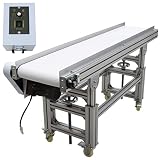
- The conveyor consists of aluminum frame, 0.08inch white PVC belt, power motor and speed controller.
- Frames are made of aluminum and connected by screws for stability. The max. load bearing is 66-110lbs. If belt deviation happens, adjust the screw on the motor side.
- The height is adjustable from 27.5inch-35.4inch. It also has baffles on both sides for protecting the objects from falling off the conveyor belt.
- The speed of belt is adjustable. The adjustable range is 0-20m/min to ensure that it can work perfectly with your automatic machine.
- This is a flat conveyor, mainly used to transfer the bottles, electronic parts, plastic bag, paper box, etc for automated production for food, beverage, cosmetics, printing industries.
Best Industrial Drive Flat Belts Buying Guide
Before choosing the best industrial drive flat belts you should consider following options:
1. Belt Design: In order to figure out the type of belt you need, you first need to know the type of drives you are using. There are three main types of drives:
Horizontal drives: These drives are similar to car engines and have one shaft that the belt drives. Most domestic appliances such as washing machines, dryers, and dishwashers have these types of drives.
Vertical drives: These drives have two shafts, one to drive the mechanism, and one to provide power to the belt. Examples of this type of drive are air-conditioning units and water pumps.
Radial drives: These drives have one or more shafts that have an outer ring and an inner ring. The belt drives the outer ring, and the inner ring is connected to the motor.
2. Belt Pitch: The pitch of a belt refers to the distance between the two drive ridges on the belt. The distance between the two ridges is important to know when buying a belt because the belt will be fully engaged or disengaged depending on the distance.
3. Belt Length: You also need to know the length of the belt that you need. There are three standard belt lengths: long, medium, and short. Long belts are used when there is ample space between the motor and the driven equipment. Short belts are used when there is limited space between the motor and equipment.
4. Belt Construction: The type of belt construction and the materials used in the belt will determine the durability and lifespan of the belt. For example, a poly V-belt is stronger and lasts longer than a standard V-belt.
5. Belt Installation: Before purchasing a belt, you need to make sure that you have all the necessary tools and accessories to install the belt. If you purchase a belt, and you don’t have the tools to install it, then you will have to hire a technician or mechanic to do it for you.
6. Cost: The cost of a belt will depend on the type of belt, the materials used in the belt, and the length of the belt.
7. Compatibility: When choosing a belt, you also need to make sure that the belt is compatible with the motor and the driven equipment. It is also important to make sure that the belt will have the right amount of tension to work smoothly.
What else you should know about industrial drive flat belts
1. What are industrial drive flat belts?
Industrial drive flat belts are belts that are used to drive industrial machinery. These belts are flat and usually made of rubber. They are often used in conjunction with pulleys to drive a variety of industrial machines.
2. How do industrial drive flat belts work?
An industrial drive flat belt is a belt that is used to drive industrial machinery. The belt is made of a flat, flexible material that is wrapped around a pulley. The pulley is connected to a motor, which turns the pulley and the belt. The belt is wrapped around a series of pulleys, which are connected to the industrial machinery. The belt moves the machinery by turning the pulleys.
3. What are the benefits of using industrial drive flat belts?
Some benefits of using industrial drive flat belts include their resistance to stretching and slipping, as well as their long lifespan. Additionally, flat belts are often less expensive than other types of belts, and they are easy to install and remove.
4. What are the disadvantages of using industrial drive flat belts?
There are several disadvantages of using industrial drive flat belts. One disadvantage is that they are not as durable as other types of belts, such as V-belts. This can lead to premature failure and unexpected downtime. Another disadvantage is that they can slip more easily than other types of belts, which can cause decreased efficiency and increased wear on drive components.
5. What are some common applications for industrial drive flat belts?
Some common applications for industrial drive flat belts are power transmission, conveying, and belt printing presses.
Conclusion
On the market, there are numerous best industrial drive flat belts. Hopefully, the list of the top ten best industrial drive flat belts will save you time researching and deciding on the best one for you.