
On the up and up with model trains? You’re not alone. Model trains are a popular hobby that, even if you start on a small scale, can quickly become an expensive passion. There’s a wide range of products on the market from starter sets to elaborate, rumbling engines. But there’s one thing that can limit a hobbyist’s options: space.
Most hobby train sets require an entire room to operate at full speed, full volume. However, if you’re looking for a quieter, more compact set, there are some options out there.
Read on to learn more about the best hobby train steam locomotives.

Our Editor’s Best Hobby Train Steam Locomotives Reviews

- English (Publication Language)
- 335 Pages - 11/19/2015 (Publication Date) - Kalmbach Pub Co (Publisher)

- DCC sound-equipped Econami Sound Value package, with dual- mode NMRA-compliant decoder
- Die-cast boiler and frame, separately applied handrails and stanchions, detailed backhead
- Twin brass flywheels, all-wheel pickup in engine and tender, traction-tire equipped
- Soft white LED headlight and backup light, chemically blackened wheels
- E-Z Mate Mark II couplers, Performs best on 12.50” radius curves or greater, N Scale 1:160
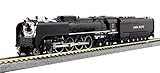
- N Scale
- Special cross-braced shock absorbers equalize the pressure on the locomotive drivers to maximize traction
- Illuminated headlight and locomotive number boards
- DCC friendly design, allowing for easy drop-in installation of DCC. All detail parts installed and ready-to-run
- 11" (282mm) minimum turning radius on ground level track, 15" (381mm) minimum turning radius on Viaduct track.

- Die cast chassis, and metal handrails
- Skew wound motor with bronze bearings, engine and tender electrical pick-up
- Traction tires for greater pulling power, preforms best on 11.25" Radius curves or greater
- E-z Mate Mark II coupler on tender
- N scale 1: 160

- Rivarossi has been around for almost 80 years since the development of Italian iron models.
- Discover our range of model railway locomotives, including steam, diesel and electric, as well as DCC enabled and ready locos to revolutionise your layout.


- AUTHENTIC DESIGN: Highly detailed HO scale steam locomotive model featuring classic black finish with red wheels and green accents, perfect for collectors
- IMPRESSIVE SIZE: Measures 13 inches in length, making it an ideal centerpiece for model train displays and collections
- REALISTIC DETAILS: Includes intricate features like textured coal tender, detailed wheel mechanisms, and authentic locomotive front design
- DISPLAY QUALITY: Premium construction with precise molding and paint application for a museum-quality appearance
- VINTAGE STYLING: Captures the essence of classic steam locomotives with period-accurate details including smoke stack, driver wheels, and tender car

- DCC sound-equipped with Econami Sound Value package
- Precision motor, die-cast boiler, underframe, and tender frame
- Separately applied detail parts and laser-cut exterior detailing
- Die-cast finescale driver spokes, E-Z Mate Mark II rear coupler
- Performs best on 12.50” radius curves or greater, N Scale 1:160

- Prototypical 0-6-0 Locomotive with Slope Tender
- Operating Smoke Unit and Headlight
- Highly Detailed Scale Model with Metal Wheels and Siderods
- Performs Best on 18" Radius Curves or Greater
- HO Scale: 1:87
Best Hobby Train Steam Locomotives Buying Guide
Before choosing the best hobby train steam locomotive you should consider following options:
1. Gauge: What gauge you choose will depend on personal preference and space limitations. The most popular gauges are HO and O, which are both a bit bigger than their 0 Gauge counterparts.
2. Locomotive Type: There is a wide range of steam locomotive types to choose from, from the standard tender and tank engine to the articulated Garratt and Mallet.
The most popular steam locomotive types for model railroad purposes are the tender engines, which include American and European types.
American tender engines have a single boiler and a single stack. The European type has three separate boilers and two separate stacks.
The tank engine is a self-contained unit, while the Garratt and Mallet types have a long boiler that is supported on either end by a pair of trucks.
3. Gauge: What gauge you choose will depend on personal preference and space limitations. The most popular gauges are HO and O, which are both a bit bigger than their 0 Gauge counterparts.
4. Locomotive Type: There is a wide range of steam locomotive types to choose from, from the standard tender and tank engine to the articulated Garratt and Mallet.
The most popular steam locomotive types for model railroad purposes are the tender engines, which include American and European types.
American tender engines have a single boiler and a single stack. The European type has three separate boilers and two separate stacks.
The tank engine is a self-contained unit, while the Garratt and Mallet types have a long boiler that is supported on either end by a pair of trucks.
5. Detail: The level of detail you want will also depend on the scale you choose, as some scales emphasize detail more than others.
For instance, N Gauge models tend to have a lot of detail and often include sound features, but the overall size of the model is small.
On the other hand, 0 Gauge models have little detail, but the overall size is quite large.
6. Power Option: Some scales of model trains can be run by hand, while others need to be powered by electricity.
It’s important to note that electric model trains are more lifelike and realistic, but they are also more expensive, require a special room for storage, and can be dangerous for children.
7. Maintenance: Maintenance on a model train will depend on the scale and type you choose, as well as the power option.
Hand-powered models are the most realistic, but they require the most maintenance because the train must be manually moved forward, stopped, and turned on a loop of track.
Electric-powered models don’t require much upkeep because the power is provided to the train by a track that is already laid out, but they are not as realistic.
What else you should know about hobby train steam locomotives
1. What is a hobby train steam locomotive?
A steam locomotive is a locomotive powered by steam. The first steam locomotive was built in 1804 by George Stephenson.
2. How do hobby train steam locomotives work?
The steam locomotive generally has a boiler that is fed water by a pump. The boiler is then fired by a burner. The steam that is generated by the boiler turns the wheels of the locomotive.
3. What are the benefits of owning a hobby train steam locomotive?
Some benefits of owning a hobby steam train locomotive include the following:
-It can be a very relaxing hobby
-Can be a great conversation starter
-Can be a fun way to bond with friends or family
-Can be a great way to relieve stress
4. How do I maintain my hobby train steam locomotive?
You will need to regularly check the locomotive for any damage or leaks. You will also need to keep the locomotive clean and lubricated.
5. What are some of the dangers of operating a hobby train steam locomotive?
Some dangers of operating a hobby train steam locomotive include burns from the steam, scalding from the hot water, and explosions from the boiler.
Conclusion
On the market, there are numerous best hobby train steam locomotives. Hopefully, the list of the top ten best hobby train steam locomotives will save you time researching and deciding on the best one for you.