
For those who are tired of wasting time sanding by hand or trying to fix the dents left behind by a vibrating sander, an industrial sander is a must-have. These machines are used to sand large areas quickly and with precision, leaving a smooth finish behind. The problem is that they can be very expensive and are often loud enough to require hearing protection.
To help you find the best industrial sander for your needs, we’ve turned to reviews from real customers on Amazon who have purchased and used these products for themselves. These best-selling items not only have near-perfect ratings, but they also have countless glowing reviews describing why they’re so great.
Read on for best industrial sander belts.
Our Editor’s Best Industrial Sander Belts Reviews

- Fully waterproof material. Can be run wet or dry. Heavy backing.
- Silicon Carbide sander belts are best for sanding of: glass, stone, granite, cement, composites, plastics and light metal finishing.
- Silicon carbide grain, closed coat, heavy duty y-weight polyester cloth backing.
- Precision engineered bi-directional tape joint, anti-clogging stearate, and resin over resin bonding for long belt life
- 12 PCS Assortment includes 2 each of 120 / 240 / 400 / 600 / 800 / 1000 Grits.

- Includes: 1/2 x 18 Aluminum Oxide sanding belts 50 pack, 10 each of 40/80/120/180/240 Grits.
- Perfect Fit – 1/2" x 18" Sanding Belts: Compatible with popular mini belt sanders, bandfile sanders, porter cable belt sander including WEN 6307, Milwaukee M12 & M18 band file, Dewalt band file, Astro 3037 air belt sander, and more. Works with 1/2 x 18 detail belt sanders for woodworking, metal and auto body projects.
- Premium Abrasive Construction: Made with industrial-grade grains on strong X-weight cloth backing. Delivers longer belt life and consistent sanding results compared to generic sanding bands or sandpaper sheets.
- Versatile Applications: Perfect for heavy stock removal, surface prep, deburring, rust removal, finishing, and shaping. Works on wood, metal, aluminum, fiberglass, plastic, rubber, and non-ferrous metals – ideal for both hobby and industry-grade sanding projects.
- Smooth & Efficient Performance: Open-coat design resists clogging and loading, giving uniform sanding action across all materials. Great alternative to sanding discs, sanding bands, or detail sander pads when you need precision with a band file sander.
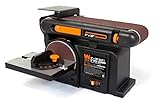
- Two-in-one sanding machine includes both a 4-by-36 inch belt and a 6-by-6 inch disc
- Belt tilts anywhere from 0 to 90 degrees
- Sturdy cast iron base prevents any heavy vibrations
- 4.3 Amp motor provides up to 3600 RPM
- Tension release lever provides for simple changes between sandpaper grits

- [HEAVY-DUTY WEAR] X-Weight Cloth. Rigid Polyester Backing bonded with Resin-over-Resin resists stretching and snapping. Engineered for High-Load Stock Removal on Hardwood Slabs and Steel Beams without tearing.
- [SMOOTH & QUIET RUNNING] Reinforced Butt-Joint. Ends are precision-ground and taped flush for a seamless loop. Eliminates vibrations and "seam hop" to ensure flat results when Squaring Metal Parts or Jointing Lumber.
- [FITS INDUSTRIAL SANDERS] Reversible Installation. Precision-cut to 6 x 48 inches for standard stationary sanders. Bi-Directional Tape allows setup in either direction, ensuring fast, arrow-free belt changes.
- [5-PACK / 5 GRITS] Complete Grit Range. Includes 1 belt each of 80, 120, 150, 240, 400. Professional sequence handles everything from Aggressive Material Removal to Stain-Ready Surface Finishing.
- [PROFESSIONAL QUALITY] Anti-Clog & Consistency. Strictly graded particles and Premium Aluminum Oxide prevent glazing on Metal and Resinous Wood. Delivers a uniform, chatter-free finish across all Industrial Grinding tasks.
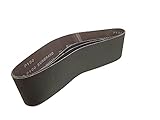
- For use on wood metal plastic paint removal heavy stock removal
- Strong X-weight heavy duty tear resistant 65/35 polyester/cotton backing for longer cutting and heavy stock removal
- Extra strong tape joint can be run in both directions for extended life and quicker belt changes and won't break
- P graded aluminum oxide grain provides fast smooth cut while fracturing to create new cutting services extending abrasive life
- Full resin on resin bond offers extended belt life and medium open coat is excellent for reduced loading

- Wide Application: This Belt sander is perfect for sanding and grinding jobs on virtually all metals including steel, aluminum, brass and more.Used for grinding, polishing, concave surface treatment, napping, rust removal of non-metal, wood, leather, fabric, glass, lacquer, rubber, etc.
- Rotate 180°Adjustable Angle:The air belt sander can be adjusted to the required angle for rotating and grinding according to actual needs. Especially suitable for spot welding parts grinding, polishing, rust removal, deburring solder joint treatment, etc.
- Durable Design: Suitable for belt size of 1/2" x 18". No need to assemble. Allows to quickly replace the sanding belt (Comes with air inlet interface,wrench & 3 pcs sanding belt 36/40/60# ),the ergonomic handle is comfortable to grip.
- Speed Adjustment Button: RPM adjustment located on rear of handle allows for fine tuning the speed required for your application up to 16,000rpm.
- Easy to Use: With the simply trigger switch,easy to operate. No fatigue after long time use.SAFETY INFORMATION: Read all instructions to follow all instructions listed

- Powerful Performance: Equipped with a 1500W pure copper motor running at 2900 rpm, the VEVOR belt grinder sander delivers superior grinding power, quieter operation, and enhanced durability compared to ordinary motors. Enjoy smooth running and stable tracking without worrying about overheating.
- Variable-Speed Control: Featuring a belt line speed of 32m/min and a VFD variable frequency drive, this belt polisher knife sharpener allows for stepless speed regulation. Easily switch between high-speed fast and low-speed fine sanding work, boosting working efficiency and protecting the motor.
- Compatible with 72"- 82*2" Belts: Versatile and adaptable, this variable-speed belt sander can accommodate 72 - 82 x 2 inch sanding belts. And we have included three 72*2 inch belts of varying grits (100 grit, 180 grit, and 240 grit), cater to both coarse and fine sanding needs effectively.
- Versatile 3-in-1 Belt Sander: VEVOR bench belt sander offers 3 grinding modes: circular, arc, and flat grinding, providing versatility for different applications. Whether you're grinding, polishing, or deburring metals, plastic, wood, glass, or other materials, this belt grinder is perfect for achieving professional results with ease.
- Support Vertical & Horizontal Use: Designed for both vertical and horizontal usage, this belt sander abrasive machine handles different angles effortlessly. Its reinforced steel body ensures sturdiness for smooth working, while the detachable workbench allows for finding the perfect working position.

- Belt Sander Paper PRO:Sanding belts are crafted with selected premium open coat aluminum oxide grain, feature excellent abrasion resistance, anti-static and anti-clogging. No such "A lot of fall out of the grits and fiber" occurred in normal use
- Strong Connection at the Seam:Sanding belts' thoughtfully diagonal lap splice minimize bulges at the joints to maximize the strength of seam connection for a smoother experience and less "belts coming apart" issue, compared to other similar products
- Max Performance:Sander belts works perfectly with an assortment of belt sanding machines and applications, offering a heavy-duty stripping and sanding tool for wood, aluminum, fiberglass, rubber, plastic and non-ferrous metals
- Total 20 PCS having Grits Indication on the cloth backing:20 belt sander sandpapers consist of 3 PCS each of 60/80/120/150/240/400 Grits and 2 of 40 Grits, meeting all your requirements for different materials. Grits have been indicated on the backing to be clearly viewed
- Grit Selection Guide:60 Grit sanding belt is fairly coarse - Heavy Sanding and Stripping; 80-150 Grit sandpaper is fairly medium - Removing Tiny Imperfections; 240-400 Grit Delivering a Super Fine Smooth Finish

- High-power heavy duty pipe tupe polishing sander,1280W powerful pure copper wound motor,maximum speed 11000 rpm,high efficiency,and excellent performance,can be in the shortest time finish polishing and grinding work.
- Pipe sander adopts a triangular design, which can form 180 degrees of contact surface on the pipeline surface.Non-slip handle are ergonomically,which is very conducive to the stability of operation. Polishing of tube or pipe becomes effortless,Professional tool for removing metal rust.
- The high quality guide wheel is wear resistance and has long service life.The Design of the guide pulleys can make sure holding the belt tightly thus not going to sway and suitable for two sand belt width specifications of 20mm and 40mm,Giving you a precise sanding work.
- Our hand held pipe grinder sander comes with 30pcs of high-quality aluminum oxide sand belts, including two types: soft cloth sand belts and hard cloth sand belts, which can meet different grinding surface requirements. 5 different grits can complete grinding from coarse to fine, and the grinding work can be easily completed without the need to purchase additional sand belts.
- Our pipe tupe polishing sander is Suitable for round tube type, stainless steel, iron parts, aluminum parts, non-ferrous metal,plastic and wood. Widely used in painting,rust removal,welding handle, Texturing, grinding, polishing, brushing, smoothing and mirror polishing.

- Pressure control technology warns user when excessive pressure is applied
- 6.0 A of power sands any type of wood surface
- Micro-filtration captures and contains fine dust particles
- Auto track belt alignment keeps belt centered
- Vacuum compatible - fits standard 1-1/4 IN. vacuum hoses
Best Industrial Sander Belts Buying Guide
Before choosing the best industrial sander you should consider following options:
1. Sander Types: Before selecting the type of sander you need to purchase, you first need to understand the different types available. Some of the most common are:
Random-orbit sanders: These are the most popular sanders for woodworkers and DIYers. The random-orbit action of the disk ensures an even finish with no marks on your wood.
They are fast and powerful and ideal for all-round sanding, but the dust extraction is often poor, so wear a mask.
Pad sanders: These are ideal for sanding large surfaces, such as wooden doors or cabinets. They use a rubber pad and a backing plate to sand with and are available in different sizes.
The backing plate has holes that allow dust and air to escape, which makes them ideal for workshop use.
Bench sanders: These are ideal for heavy-duty jobs such as sanding a large tabletop.
They are available in either a fixed or a portable version and are very versatile for sanding wood and metal.
Disc sanders: These are similar to random-orbit sanders but have a larger, wider pad and a smaller orbit.
They are ideal for sanding large surfaces and work best on rough materials and with a backing pad for dust extraction.
Strobe sanders: These are for woodworking and metalworking, but they can also be used for paint stripping.
They use a narrow pad with a special attachment to make a straight line of holes in the wood.
They are very powerful but only suitable for rough sanding.
Drum sanders: These are the most powerful sanders available and are ideal for workshop use.
They use a belt to drive the sanding drum and the belt can be changed for different applications. They are ideal for sanding large surfaces and working on metal.
The dust extraction is often poor, so wear a mask.
Fixed-belt sanders: These are similar to drum sanders but the belt is mounted on an adjustable plate.
They are ideal for sanding large surfaces and are also often used for metalworking.
2. Pad Size: The size of the sanding pad is important, especially if you will be using the sander with a wet-and-dry vacuum attached.
If you are going to be using the sander for woodworking, then make sure you choose one with a pad that is the right size for your project.
3. Power Source: Most sanders use electricity as the power source and they are available in a range of voltages.
The power source you choose depends on the tasks you will be using the sander for and whether you will use it in a workshop or on a job site.
If you will be using it in a workshop, then a 240-volt model is ideal for heavy-duty sanding. If you will be using it on a job site, then a 120-volt model is ideal for portable use.
4. Belt Size: The belt size of a sander is also important to consider, especially with drum sanders. The drum size will determine what materials you can work with and how smooth the finished product will be.
If you need to sand large materials, such as wooden roof sheets, then a drum sander with a large belt is essential.
5. Cost: The cost of the sander is obviously an important consideration, especially if you are working on a budget.
There are different types of
What else you should know about industrial sander belts
1. What are the different types of industrial sander belts?
The different types of industrial sander belts are:
1) Rough sanding belts: These belts are used for removing large amounts of material quickly, and are often used on wood or metal.
2) Medium sanding belts: These belts are used for removing medium amounts of material, and are often used on wood or metal.
3) Fine sanding belts: These belts are used for removing small amounts of material, and are often used on wood or metal.
2. What are the benefits of using an industrial sander belt?
Some benefits of using an industrial sander belt include increased speed and efficiency when sanding large surfaces, as well as a more even sanding finish. Additionally, belts are less likely to clog than other types of sanders, and they can be easily replaced when worn.
3. How do you choose the right industrial sander belt for your needs?
You should consider the type of sander you are using, the type of material you are sanding, and the desired finish.
4. How do you care for and maintain your industrial sander belt?
To care for and maintain your industrial sander belt, you should regularly clean it with a brush or vacuum, and apply a light coat of lubricant. You should also inspect it regularly for wear and tear, and replace it when necessary.
5. What are some of the most common problems with industrial sander belts?
The most common problems with industrial sander belts are that they can break easily, they can wear out quickly, and they can be difficult to change.
Conclusion
On the market, there are numerous best industrial sander belts. Hopefully, the list of the top ten best industrial sander belts will save you time researching and deciding on the best one for you.